
Types
Types of Home Lifts in the UK: Complete 2026 Guide
The six main types of home lift available in the UK are hydraulic lifts, traction (cable-driven) lifts, vacuum (pneumatic) lifts, platform lifts, through-floor lifts, and residential elevators. Prices range from £13,000 for a basic through-floor model to £40,000+ for a full residential elevator. Each type differs in space requirements, speed, weight capacity, and installation complexity.

Stairlifts
A stairlift is a seat on a rail fixed to the stairs. It is the cheaper option when the user can still get on and off a seat safely, and it does not take anyone between floors in a wheelchair.
Hydraulic Home Lifts
A hydraulic home lift uses a hydraulic power unit to drive the car. In UK homes they are through-floor lifts from Terry and Wessex, carrying 250 to 325 kg at 0.06 m/s on most models.
They need a dedicated electrical supply, and neither maker publishes a price.
Platform Lifts
A platform lift carries a wheelchair user on an open or enclosed platform. Short-rise versions lift over a few steps; shaft versions from Aritco and Cibes serve up to six floors.
Residential Elevators
A residential elevator is a cabin lift in its own shaft, such as the Cibes C1 Pure, which carries up to 630 kg over up to six floors. It needs a 100 mm pit.
Vacuum Home Lifts
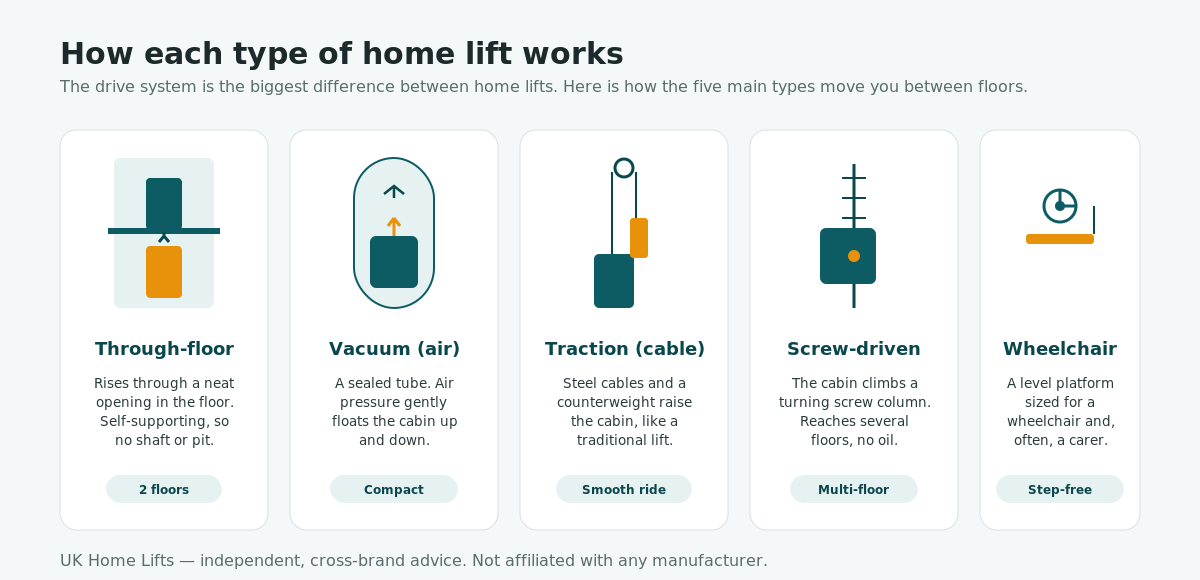
A vacuum lift moves a round cabin inside a clear tube using air pressure. It needs no pit but does need a tall ceiling upstairs.
Benefits of Installing a Home Lift in Your UK Property
None of the 29 home lifts we track needs a machine room. Through-floor and vacuum lifts need no pit; shaft lifts need a shallow recess of 37 to 100 mm or a ramp.
Top Homelifts
Traction Home Lifts
Traction lifts are driven by a rope or drum. In UK homes most of them are through-floor lifts serving two floors.
Vacuum Home Lifts
Vacuum lifts move a cabin inside a clear tube using air pressure, over two to five stops.
Electric Home Lifts
Every home lift runs on electricity, so “electric” is a loose label. They can go in new or existing homes.
Reconditioned Home Lifts
Reconditioned home lifts are used lifts refurbished and refitted, usually with a shorter warranty. They cost less than new.
Through Floor Home Lift
Through-floor lifts travel through a hole cut in the ceiling on their own rails, with no shaft.
Wheelchair Home Lift
Wheelchair home lifts have a car large enough for a standard wheelchair, such as the Stiltz Trio+ or Aritco HomeLift Access.
Comparing types side by side? Our home lift type comparison puts traction, hydraulic, screw-drive and vacuum lifts in one table, with the published specifications and prices of 29 UK lifts.
Home Lift Types: Frequently Asked Questions
Frequently Asked Questions For Types Of Home Lifts
What Types Of Home Lifts Are Available In The Uk?
Through-floor lifts (rope or hydraulic), shaft and platform lifts (screw-driven), and vacuum lifts. Stairlifts are a separate product.
What Is A Platform Lift?
A lift with a platform instead of a closed car, sized for a wheelchair. Home versions from Aritco and Cibes come in their own enclosure.
What Is A Stairlift?
A seat that runs on a rail fixed to the stairs. It suits someone who can still transfer to and from a seat.
What Is A Through-Floor Lift?
A lift car that travels through a hole cut in the ceiling on its own rails. Every model we checked serves two floors.
Do Domestic Lifts Need A Lift Car?
Most do. Some platform lifts have an open platform instead of a closed car.
What Are The Benefits Of Installing A Home Lift?
Someone who cannot manage the stairs can reach the other floor without help. Whether it adds value to the house depends on the buyer.
How Much Does A Home Lift Cost In The UK?
It depends on the type.
Published starting prices run from £13,000 ex VAT for a through-floor lift to £18,000 to £27,000 for a screw-driven shaft lift and £29,500 for a vacuum lift.
Is It Necessary To Have A Shaft For A Home Lift?
No. Through-floor and vacuum lifts need no shaft. Shaft lifts from Aritco, Cibes and SWIFT come with their own enclosure, so no builder’s shaft is needed.
Are Home Lifts Suitable For People With Disabilities?
Yes, if the car fits the user. Wheelchair users need a wheelchair-rated model, and an occupational therapist can advise.
Do You Need A Separate Machine Room?
No. None of the home lifts we track needs a machine room.
Is A Hydraulic Elevator The Same As A Hydraulic Lift?
Yes. “Elevator” is the American word for a lift.
Not sure which lift suits your home? Use our free Home Lift Cost Calculator & Lift Type Finder to get a 2026 price estimate and the right lift type in under a minute. Check grants and funding or compare a stairlift vs a home lift.
Home Lift Types Compared: Price, Speed & Installation (2026)
| Lift Type | Price Range | Install Time | Pit Required? | Max Floors | Best For |
|---|---|---|---|---|---|
| Through-Floor | £13,000–£25,000 | 1–3 days | No | 2 | Two-storey homes, compact spaces |
| Traction (Cable) | £25,000–£55,000 | 3–5 days | Shallow | 4+ | Multi-floor, smooth ride |
| Hydraulic | £22,000–£50,000 | 3–5 days | Yes (small) | 3–4 | Heavy capacity, wheelchair use |
| Vacuum (Pneumatic) | £20,000–£45,000 | 1–2 days | No | 3 | No pit/machine room, retrofit |
| Platform | £8,000–£15,000 | 1–2 days | Minimal | 1 (short-rise) | Wheelchair access, short rise |
| Residential Elevator | £25,000–£40,000+ | 1–2 weeks | Yes | 5+ | Luxury, multi-storey homes |